Archives October 2026

Programmable crystal replacement (Si5351)

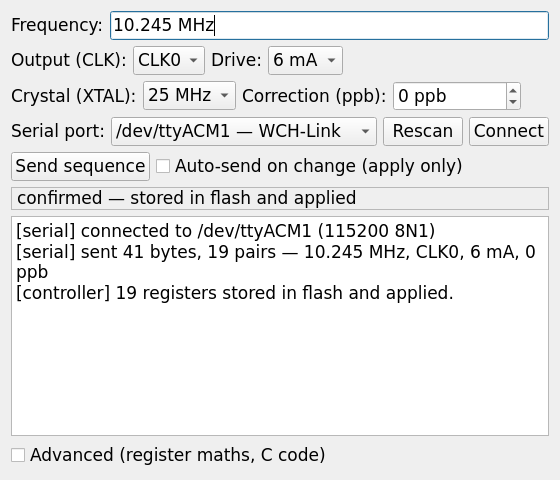
Odd crystal frequencies are hard to buy and expensive to have cut. This turns a CH32V003 (~$0.30, 8 pins) plus a common Si5351A breakout into a drop-in replacement: set the frequency once over USB, and the board comes up on that frequency every time it is powered, with no PC attached.

Typical uses: a 10.245 MHz IF crystal, an 11.0592 MHz baud-rate clock, a 3.579545 MHz colour burst, a 24.576 MHz audio master clock — anything the shop does not stock.

  • Range 3.907 kHz – 133.333 MHz
  • Accuracy better than 0.05 ppm — measured across 14 typical frequencies, worst case 0.044 ppm
  • Outputs CLK0–CLK7, drive strength 2 / 4 / 6 / 8 mA
  • 25 or 27 MHz reference with ppb correction, trimmable against a counter
  • Setting stored in the MCU’s flash and restored on power-up
  • Optional second frequency (B), selected by grounding pin 3 — e.g. a BFO switching USB/LSB

Source code and downloads: github.com/freetoair/ch32v003-si5351-xtal
Si5351 filter sweeper

A simple scalar filter sweeper built from a CH32V003 (a ~$0.30 RISC-V microcontroller in 8 pins), a common Si5351A breakout and an AD8307 log-detector. The board steps a clean, accurately known frequency across a range, the detector reads what comes out of the filter, and the PC draws the curve — made for aligning crystal filters: centre, bandwidth, shape factor and ripple, live while the trimmers are turned.

  • Range 3.907 kHz – 100 MHz, 11–2000 points per sweep
  • Synthesis better than 0.05 ppm; correction trimmed against a counter and stored on the board
  • 201 points at 5 ms dwell in ~1.6 s, continuous mode for live tuning
  • ~70–80 dB usable depth (AD8307, 0.08 dB noise measured)
  • Readings: centre (−6 dB), bandwidth at −3/−6/−60 dB, shape factor 60/6, passband ripple, loss vs. a thru calibration
  • Single test frequency on demand, CLK0–7, 2–8 mA drive

Source code and downloads: github.com/freetoair/ch32v003-si5351-sweeper

Intermod — interference product calculator

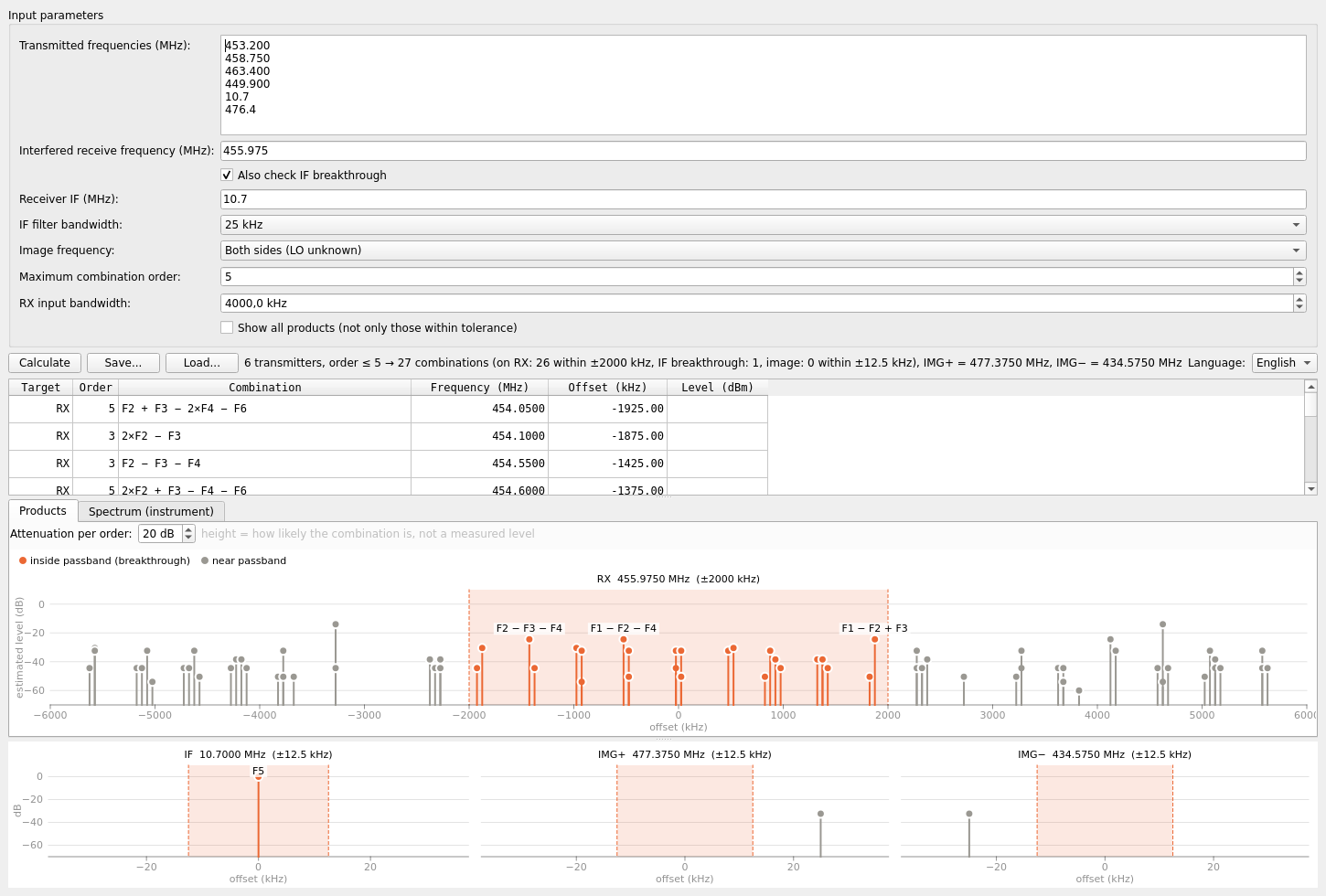
A desktop tool for radio sites: give it the frequencies transmitted at a location and the frequency on which a receiver is being interfered with, and it finds every intermodulation / harmonic product |k1·F1 + k2·F2 + … + kn·Fn| that can explain the interference — on the receive frequency, directly on the receiver’s IF, or on the image frequency.

It can also read a spectrum trace straight from an Anritsu MS2711D Spectrum Master (or load one from CSV) and use the measured transmitter levels to estimate how strong each product really is.

  • Any number of transmitters, combination order up to 10 (harmonics included)
  • RX / IF / Image breakthrough, each checked in its own passband
  • Graphical view: one panel per target, passband shaded, hover for details
  • Measured levels from an MS2711D over RS-232, or from a CSV file
  • English / Serbian user interface

Source code and downloads: github.com/freetoair/intermod